What does a hot flash feel like? Sudden or slow build, how long it lasts, and what's normal
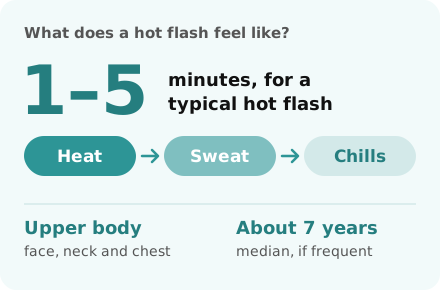
A hot flash is a sudden wave of heat that spreads through your chest, neck and face. Your skin may go red, your heart may race, and you start to sweat. It usually passes within 1 to 5 minutes, and as the heat fades you can feel chilly or shivery, especially if you’re damp with sweat.
If you’ve never had one, that description can still feel vague. Ask women who get them and the answers range from “like someone opened an oven door in my face” to “a fever that starts inside my head”. This guide explains what usually happens, why it feels the way it does, and how to tell a hot flash from something else.
In short:
- A hot flash feels like intense heat rising through the upper body, often with flushing, sweating and a faster heartbeat.
- Most come on suddenly, but many women feel a brief build-up or warning first.
- A typical hot flash lasts 1 to 5 minutes. Some are over in seconds, and a few last longer.
- Chills afterwards are common. Some women get cold flashes instead of hot ones.
- At night they’re called night sweats and can wake you up soaked.
What a hot flash feels like, step by step
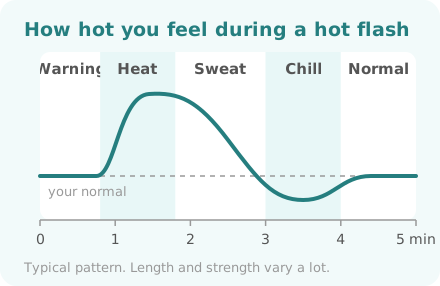
No two women describe it in exactly the same way, but most hot flashes follow the same pattern:
- A warning, sometimes. A few seconds before the heat, many women notice something is about to happen: a sense of unease or dread, pressure in the chest or head, a racing heart, or a wave of nausea.
- The heat. Warmth rises quickly, usually from the chest up into the neck, face and head. It can feel like it’s coming from inside your body rather than from the room. Your face and chest may look flushed or blotchy.
- The sweat. Your body tries to get rid of the heat. Sweat breaks out on your face, scalp, chest or back. For some it’s a light sheen, for others it’s dripping.
- The cool-down. Once the heat passes, the sweat keeps cooling you, so you can go from boiling to chilly within a minute or two. Some women shiver.
Hot flashes can also come with anxiety, irritability, a pounding heart, dizziness or a headache. That’s why the first few can feel frightening, especially if you didn’t know they were coming.
Is a hot flash sudden or a slow build-up?
Both are normal. Most women describe hot flashes as sudden: one moment the room feels fine, the next they’re burning up. Others feel the heat creep up for a little while before it peaks. Many get both kinds, and the pattern can change over the years. When hot flashes first start they’re often milder and build more slowly.
The warning signs in step 1 are why some women say they can “feel one coming”. If you get them, a few slow, deep breaths as soon as you notice can sometimes take the edge off.
Where in your body you feel it
Hot flashes are felt mostly in the upper half of the body:
- Face, ears and scalp, often the strongest part
- Neck and chest
- Upper back and arms
Some women feel it spread from the waist or navel upwards, and some feel it all over. Flushing, if you get it, usually shows on the face, neck and upper chest.
How long does a hot flash last?
A typical hot flash lasts 1 to 5 minutes. Some are over in under a minute, and occasionally one lasts 10 minutes or longer.
How often they come varies just as much. Some women get one or two a week, others many a day. They can cluster, so you get several in a row and then nothing for days.
How many years do hot flashes last?
Usually longer than people expect. In the large US study SWAN, women with frequent hot flashes or night sweats had them for a median of about 7.4 years in total, and for about 4.5 years after their last period. Women whose hot flashes started early in perimenopause tended to have them the longest.
For many women they’re strongest in the year or two around the last period and then slowly fade. For a smaller number they carry on into their 60s. If you’re not sure where you are in the transition, here’s at what age periods usually stop.
Night sweats: hot flashes while you sleep
Night sweats are hot flashes that happen at night. They can:
- Wake you up hot, with your heart pounding
- Leave your pyjamas, sheets or pillow damp, sometimes soaked
- Make you cold and shivery afterwards, so you’re throwing the covers off and pulling them back again
Even milder ones can break up your sleep without fully waking you. If you’re waking at the same time every night, here’s why perimenopause can wake you at 3 am.
Cold flashes and chills
Not every flash is hot. Some women get cold flashes: sudden chills or shivering, sometimes with goosebumps, which can last a few minutes. Chills are also common straight after a hot flash, as sweat evaporates and your body overcorrects.
Cold flashes come from the same temperature control problem as hot ones. They’re less talked about, but they’re a recognised menopause symptom.
Why hot flashes happen
Your brain has a temperature control centre, the hypothalamus, which keeps your core temperature within a comfortable range. Normally that range is quite wide, so small changes don’t trigger anything.
As oestrogen falls in perimenopause and menopause, the range narrows. Now even a tiny rise in core temperature, from a warm room, a hot drink, alcohol or stress, makes your brain think you’re overheating. It responds by widening blood vessels in the skin and switching on sweating to dump heat fast. That’s the flush and the sweat. Your skin temperature can rise by several degrees, even though your core temperature barely changes.
This is also why the triggers are so varied. Here’s our list of 27 common hot flash triggers and how to find yours.
Is it a hot flash or something else?
Hot flashes in your 40s and 50s are usually down to perimenopause or menopause, but other things can feel similar:
- A fever. A real fever shows up on a thermometer under the tongue and lasts for hours, often with other signs of illness. A hot flash passes within minutes. An ear or skin thermometer can read high during a hot flash, because your skin really does heat up.
- Thyroid problems, especially an overactive thyroid, which can cause heat intolerance, sweating and a racing heart
- Anxiety or panic attacks, which can cause sweating, flushing and a pounding heart. The two often overlap in perimenopause (more on anxiety out of nowhere).
- Medications, including some antidepressants, and treatments that lower oestrogen, such as some breast cancer drugs
- Alcohol, caffeine and spicy food, which can cause flushing on their own
- Low blood sugar, which can cause sweating and shakiness
If you’re unsure, it helps to note when each episode happens, how long it lasts and what you were doing just before. The 2-minute perimenopause quiz can also show whether your other symptoms point to perimenopause.
When to see a doctor
See a doctor if:
- Hot flashes or night sweats are affecting your sleep, work or mood. You don’t have to put up with them, and treatment works well for most women.
- You have night sweats with fever, weight loss you can’t explain, a cough or swollen glands
- You get hot flashes before 45, or your periods stop before 45
- Episodes come with chest pain, fainting or a very irregular heartbeat
- They started after a new medication
What helps
The most effective treatment is hormone replacement therapy (HRT), which reduces hot flashes for most women. If you can’t or don’t want to take HRT, there are non-hormonal medicines a doctor can prescribe, and cognitive behavioural therapy (CBT) has good evidence for making hot flashes less distressing.
Day to day, these can help:
- Layers you can take off quickly, and breathable fabrics
- A cool bedroom, a fan by the bed and light bedding
- Slow, deep breathing as soon as you feel one starting
- Cutting back on your personal triggers, once you know what they are
Tracking for a couple of weeks is the quickest way to find out. Here’s why tracking hot flashes actually helps, and you can use our free printable tracker. If you’re seeing a doctor, here’s what to bring to a menopause appointment.
Common questions
What does your first hot flash feel like?
Often it’s milder than people expect: a sudden feeling of being too warm, a flushed face, maybe a little sweat. Many women aren’t sure it was a hot flash at all until they start having them regularly.
Can you feel a hot flash coming on?
Many women can. A few seconds before the heat, you might feel uneasy or anxious, notice your heart speeding up, or feel pressure in your head or chest.
Does a hot flash raise your temperature?
Your skin temperature goes up, sometimes by several degrees, which is why you feel so hot and why an ear or forehead thermometer can read high. Your core temperature barely changes, and it often dips slightly afterwards, which is why you can feel chilly.
Can hot flashes make you feel sick?
Yes. Nausea, dizziness and a headache can come with a hot flash, either just before or during it.
Can you have hot flashes and still have periods?
Yes. Hot flashes often start in perimenopause, while you’re still having periods, sometimes years before your last one.
Why do I get chills after a hot flash?
The sweat your body produced to cool you down keeps cooling you after the heat has passed. Your body temperature can drop slightly below normal, so you feel cold or shivery.
The bottom line
A hot flash is a sudden rush of heat through the upper body, usually followed by sweat and sometimes chills, and it’s over within a few minutes. It can come on in a flash or build for a moment first, and both are normal. If they’re getting in the way of your days or nights, they’re worth talking to a doctor about. Start by tracking a few weeks so you have something concrete to show them.
Sources
- NHS: Menopause symptoms and Hormone replacement therapy (HRT)
- NICE: Menopause: identification and management (NG23)
- Cleveland Clinic: Hot flashes
- Avis NE et al. Duration of menopausal vasomotor symptoms over the menopause transition. JAMA Internal Medicine, 2015 (the SWAN study)
- Freedman RR. Menopausal hot flashes: mechanisms, endocrinology, treatment. Journal of Steroid Biochemistry and Molecular Biology, 2014
This article is for general information and isn’t medical advice. Always speak to a qualified healthcare professional about your symptoms.
This article is for general information only and is not medical advice. Always consult a licensed healthcare provider about your symptoms.