Perimenopause itchy skin: why it happens, where it shows up and why it's worse at night
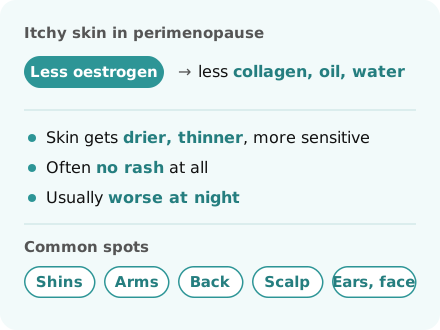
Itchy skin in perimenopause is real, common and rarely mentioned. As oestrogen falls, skin makes less collagen and oil and holds less water. It gets thinner, drier and more easily irritated, and dry, irritated skin itches. The itch often shows up with no rash at all, tends to move around the body, and for many women is worst at night.
If you’ve been scratching your shins or scalp and wondering whether it could be hormones, it might be. This guide explains why it happens, the places it usually shows up, what helps, and the signs that something else is going on.
A note on spelling: oestrogen (UK) and estrogen (US) are the same hormone. You’ll see both, depending on where an article or study comes from.
In short:
- Oestrogen helps keep skin thick, oily and well hydrated. When it drops, skin gets drier and thinner, and dry skin itches.
- The itch can show up almost anywhere, but the shins, arms, back, scalp, ears and face are common spots, plus skin folds where sweat collects.
- It’s often worse at night, partly because of how your skin and body change in the evening.
- Moisturising, gentle washing and cooler nights help most women. HRT improves skin hydration for some.
- See a doctor if the itch is severe, all over your body, comes with a rash that won’t settle, or comes with night sweats, weight loss or tiredness.
Why perimenopause makes your skin itch
Your skin has receptors for oestrogen, and oestrogen does a lot of quiet work there. It helps skin:
- Make collagen, which keeps it thick and firm
- Hold on to water, by supporting the molecules that trap moisture in the skin
- Produce oil (sebum), which seals that moisture in
- Repair its outer barrier, the layer that keeps irritants out
As oestrogen levels swing and then fall in perimenopause, all of this slows down. Skin loses collagen fast: studies estimate women lose around 30% of their skin collagen in the first 5 years after menopause, and skin thickness keeps falling with each year after that. The outer barrier also gets weaker, so the skin loses water more easily and reacts more to soap, heat, wool and fragrance.
The result is skin that’s drier, thinner and more sensitive, and those are exactly the conditions in which the nerves in your skin start sending itch signals. This is also why itching can start in your 40s, while you’re still having periods. You don’t have to wait until menopause for oestrogen to start dipping.
Where it shows up
Perimenopause itch doesn’t stick to one place. Common spots include:
- Shins and lower legs, where skin has fewer oil glands and dries out first
- Arms and the upper back, including the spot between the shoulder blades you can’t quite reach
- Scalp, ears and face, sometimes with flaking
- Skin folds, such as under the breasts, the armpits and the groin, where sweat and friction add to the irritation
- The vulva and vagina, where low oestrogen can cause dryness, burning and itching. Doctors call this genitourinary syndrome of menopause, and it’s very treatable.
Many women find the itch moves around: the scalp one week, the legs the next. Others get it in one stubborn patch. Both are common.
Some women also describe a crawling or tingling feeling, as if something is moving on the skin, even though nothing is there. It’s called formication. It’s unpleasant, but on its own it’s usually harmless.
Why it’s worse at night
If you mostly itch in bed, you’re not imagining it. Itching of almost any cause tends to get worse in the evening and at night, because of how your body changes on a daily rhythm:
- Your skin warms up. In the evening blood flow to the skin increases and skin temperature rises, and warmth makes itch stronger.
- Your skin loses more water. The skin barrier is leakier at night, so already dry skin dries out further.
- Cortisol is at its lowest. Cortisol is the body’s own anti-inflammatory hormone, and it’s lowest around midnight.
- There’s nothing to distract you. During the day your brain filters out a lot of mild itch. Lying in the dark, you notice every bit of it.
In perimenopause, night sweats can add to this. Being hot, then damp, then cold is hard on dry skin. If you’re also waking in the early hours, here’s why perimenopause can wake you at 3 am, and here’s more on what hot flashes and night sweats feel like.
What helps
Most perimenopause itch gets much better with skin care aimed at putting moisture back and protecting the barrier:
- Moisturise every day, ideally within a few minutes of washing while the skin is still a little damp. Thicker creams and ointments work better than light lotions for very dry skin. Fragrance-free is best.
- Keep showers short and warm, not hot. Hot water strips the skin’s oils.
- Swap soap for a gentle, soap-free wash, and only use it where you need to.
- Pat dry instead of rubbing.
- Keep the bedroom cool and choose cotton or other breathable fabrics for bedding and nightwear. Avoid wool against the skin.
- Keep nails short, so scratching at night does less damage. Scratching makes the skin more inflamed, which makes it itch more.
- A cool, damp cloth on an itchy patch can calm it quickly.
Hormone replacement therapy (HRT) isn’t prescribed for itch alone, but in studies it has been shown to improve skin hydration, thickness and elasticity. If you’re considering HRT for other symptoms, better skin can be a welcome extra. For vulval or vaginal itching, vaginal oestrogen is a safe, effective treatment for most women, even many who can’t take HRT.
If the itch keeps you up at night, a doctor may also suggest a short course of medicine to calm it while the skin recovers.
When itchy skin is something else
Itching in your 40s and 50s is often down to dry skin and hormones, but it’s worth knowing the other causes, because some need treatment:
- Iron deficiency. Heavy or frequent periods are common in perimenopause and can drain your iron stores, and low iron can cause itching. If your periods have become heavier or closer together, a ferritin test is worth asking about.
- Thyroid problems, both underactive and overactive
- Skin conditions such as eczema, psoriasis, hives or a fungal infection, which usually show a rash or patches
- Medications, including some blood pressure tablets, opioids and statins
- Diabetes, liver disease or kidney disease
- Rarely, blood conditions such as lymphoma, especially when itching comes with night sweats and weight loss
Our guide to perimenopause blood tests explains which tests are useful in your 40s.
When to see a doctor
See a doctor if:
- The itch is severe, keeps you awake, or hasn’t improved after 2 weeks of regular moisturising
- You itch all over your body, especially with no obvious dry skin or rash
- You also have night sweats with fever, weight loss you can’t explain, swollen glands or unusual tiredness
- Your skin or the whites of your eyes look yellow
- There’s a rash, sores, bleeding or skin changes that don’t settle
- You have vulval itching that doesn’t go away, or white, thickened or sore patches of skin there
It helps to note where you itch, when it’s worst and anything that seems to set it off. Our free printable tracker has space for it, and here’s what to bring to a menopause appointment.
Common questions
Is itchy skin a sign of perimenopause?
It can be. Itchy, dry skin is a common but less talked-about symptom. On its own it doesn’t tell you you’re in perimenopause, but alongside changes in your periods, hot flashes or sleep problems it fits the picture. The 2-minute perimenopause quiz can help you see how your symptoms add up.
Can perimenopause cause itching without a rash?
Yes. Often there’s nothing to see at all, or just slightly dry, flaky skin. A rash appears later if scratching irritates the skin.
Why are my legs so itchy at night?
The skin on your shins has few oil glands, so it’s one of the first places to get dry. At night your skin is warmer and loses more water, and you have nothing to distract you, so the itch feels much stronger.
Does perimenopause itching go away?
It usually eases as your skin care improves, and for many women it settles after menopause. Skin stays drier than it was in your 30s, so a good moisturising routine is worth keeping.
Can HRT help with itchy skin?
It can improve skin hydration and thickness, which may reduce itching. Vaginal oestrogen works very well for vulval and vaginal itching caused by low oestrogen.
The bottom line
Itchy skin in perimenopause comes from falling oestrogen leaving skin drier, thinner and more sensitive, and it’s often worst at night. Daily moisturising, gentle washing and a cool bedroom help most women. If the itch is severe, all over, or comes with other symptoms such as night sweats and weight loss, get it checked, because itching has other causes that are easy to test for.
Sources
- Thornton MJ. Estrogens and aging skin. Dermato-endocrinology, 2013
- Brincat M et al. Long-term effects of the menopause and sex hormones on skin thickness. British Journal of Obstetrics and Gynaecology, 1985
- Zouboulis CC et al. Skin, hair and beyond: the impact of menopause. Climacteric, 2022
- Sator PG et al. The influence of hormone replacement therapy on skin ageing: a pilot study. Maturitas, 2001
- Patel T et al. Nocturnal itch: why do we itch at night? Acta Dermato-Venereologica, 2007
- Portman DJ, Gass ML. Genitourinary syndrome of menopause: new terminology for vulvovaginal atrophy. Maturitas, 2014
- Yosipovitch G, Bernhard JD. Chronic pruritus. New England Journal of Medicine, 2013
- Polat M et al. Generalized pruritus: a prospective study concerning etiology. American Journal of Clinical Dermatology, 2008
This article is for general information and isn’t medical advice. Always speak to a qualified healthcare professional about your symptoms.
This article is for general information only and is not medical advice. Always consult a licensed healthcare provider about your symptoms.