Everything my husband does annoys me: is it perimenopause? Rage, irritability and your relationship
Yes, it can be. Irritability, a short fuse and sudden rage are common symptoms of perimenopause, and they often land hardest on the person you live with. Many women in their 40s and early 50s describe the same thing: they still love their partner, but everything he does gets on their nerves, from the way he chews to the sound of him breathing.
It isn’t a sign you’re “going crazy”, and you don’t need a psychiatrist as a first step. But it’s also not always just hormones. This guide explains why it happens, how to work out what’s hormonal and what isn’t, and what actually helps.
In short:
- Feeling irritated with your husband or partner, wanting space, or snapping over small things is a very common experience in perimenopause.
- Falling and swinging estrogen and progesterone affect mood, and poor sleep and night sweats lower your patience even further.
- It often comes in waves: bad days or weeks, then better ones. That pattern is one of the clearest clues it’s hormonal.
- It can also make old resentments and an unfair mental load impossible to ignore. Both can be true at once.
- Treatment works. Talk to a doctor about perimenopause first. Many women say HRT made a big difference to their mood.
- Don’t make big decisions on a bad day. Write down how you feel for a few weeks before deciding what the problem is.
You’re not the only one
If you’ve typed “everything my husband does annoys me” into a search bar, you’re in very large company. Women going through perimenopause describe the same experiences again and again:
- Still loving their partner, yet dreading the moment he walks in.
- Small things, like how he eats, talks or even breathes, suddenly feeling impossible to ignore.
- Short patience with everyone: children, colleagues, people in a queue.
- A cycle of snapping, then feeling guilty, then snapping again.
- Wondering whether the marriage is over, without realising hormones might be involved.
Large studies back this up. In a study of more than 16,000 women aged 40 to 55, feeling tense, low and irritable was most common in early perimenopause, more than before or after it.
The relationship part matters. Some couples split up before either of them knew perimenopause could be part of the picture. If this sounds familiar, it’s worth taking seriously now.
Why perimenopause makes you so irritable
Hormones swing, they don’t just fall. In perimenopause, estrogen can spike and crash from week to week. Estrogen affects serotonin and other brain chemicals that keep mood steady. Progesterone has a naturally calming effect, and it often drops early. The result can be a nervous system that feels permanently on edge.
Lack of sleep. Night sweats and waking at 3am are common in perimenopause. A few weeks of broken sleep is enough to make anyone short-tempered, and it makes small irritations feel huge.
Sensory overload. Many women describe noises, touch and mess becoming much harder to tolerate: chewing, breathing, someone talking while they’re concentrating, being touched when they’re already overheated. This “everything is too much” feeling is often linked to anxiety and exhaustion.
Worse PMS. If you always had some irritability before your period, it can become much stronger in perimenopause. Some women get several days of rage each cycle that they never had before.
Hot flashes and other symptoms. It’s hard to be patient when you’re burning up, aching, foggy and tired. Irritability is often the visible tip of a lot of symptoms underneath.
What it can feel like
- A short fuse: you snap over things you’d normally shrug off
- Rage that seems to come from nowhere and passes as quickly as it came
- Wanting to be alone, or looking for reasons to be out of the house
- Not wanting to be touched
- Being irritated by small habits: chewing, breathing, the TV volume, how he loads the dishwasher
- Feeling like a different person, then guilty or ashamed afterwards
- Arguing more, when you rarely argued before
Is it hormones, or is it him?
This is the real question, and the answer differs from woman to woman. For some, the irritation fades once their symptoms are treated and the relationship feels like it used to. For others, treatment calms things down but the problem is still there, because it was never only about hormones.
Perimenopause can do both: create irritability out of nowhere, and lower your tolerance for things that were never OK. A few questions can help you tell them apart.
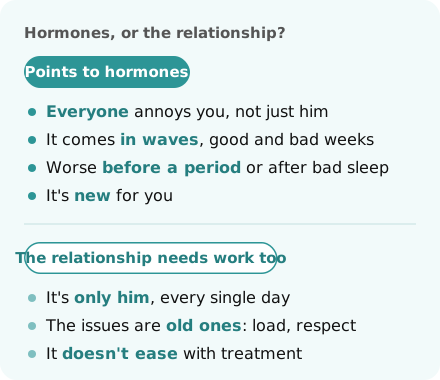
Signs it’s more likely hormonal:
- Everyone annoys you, not just him: your kids, your colleagues, strangers.
- It comes and goes. Some weeks you’re fine, others you can’t bear him.
- It’s worse before your period, after a bad night or alongside hot flashes.
- It’s new for you, and it started along with other changes like shorter cycles, poor sleep or brain fog.
- When you’re calm, you can see he hasn’t really done anything wrong.
Signs the relationship needs attention too:
- It’s only him, and it’s there every day regardless of your cycle or sleep.
- What bothers you are long-standing issues: carrying most of the housework, childcare or money, not feeling heard, not being supported.
- He dismisses how you feel, or you feel unsafe.
- It doesn’t ease even once your symptoms are treated.
The simplest way to find out: write it down
Irritability distorts memory. On a bad day it feels like you’ve always felt this way, and the good days disappear. A short daily note for 4 to 8 weeks shows you what’s really going on:
- Irritability or mood: a 1 to 5 score is enough
- Period: start dates
- Sleep: hours, and whether night sweats woke you
- Other symptoms: hot flashes, anxiety, headaches
- One line of context: an argument, a stressful day, alcohol
If the bad days cluster before your period or after bad nights, that’s a strong sign hormones are driving at least part of it. It also gives your doctor something concrete to work with, instead of “I’ve been really snappy lately”. Our guide to tracking perimenopause symptoms walks through it, or use the free printable tracker. Not sure if you’re in perimenopause at all? Try the 2-minute perimenopause quiz.
Should I see a doctor, a therapist or a psychiatrist?
For most women, start with a GP or a menopause-aware doctor, not a psychiatrist. Ask directly: “Could this be perimenopause?” Take your notes, and mention any other symptoms, even ones that seem unrelated.
- A doctor can talk you through HRT and other options, and check for things that can look similar, such as thyroid problems or anaemia.
- A counsellor or couples therapist can help if there are relationship issues underneath, or help you both handle this stage together.
- A psychiatrist is worth seeing if you’ve had depression or another mental health condition before, if your mood is very low most of the time, or if treatment for perimenopause hasn’t helped.
Get help urgently if you have thoughts of harming yourself or someone else, if you feel hopeless, or if your anger is turning physical. Contact your doctor straight away, or emergency services or a crisis line.
What helps
Hormone treatment. HRT can help with mood symptoms caused by perimenopause, including irritability and low mood. Studies suggest estrogen can improve mood in perimenopause, and many women notice a difference within weeks to a few months. If you’ve been diagnosed with depression, antidepressants are still the standard treatment, and the two can be combined. HRT isn’t right for everyone, so discuss it with your doctor.
Other treatment. If you can’t take HRT or it isn’t enough, antidepressants or other medicines may still help. CBT (cognitive behavioural therapy) has good evidence for menopause-related mood symptoms.
Protecting your sleep. Treating night sweats and improving sleep often takes the edge off irritability more than anything else.
Talking to your partner. It often gets easier once he understands what’s going on, reads up on perimenopause, and knows when to give you space. You might say something like:
“I’m not angry at you, I’m angry at everything right now. I think it’s hormonal and I’m getting it checked. On bad days I need some space. It’s not about you.”
Asking for space instead of starting a fight. A walk, a separate room, an hour alone. Taking yourself out of the moment isn’t rejecting him.
Not deciding anything big on a bad day. Hormonal irritability rises and falls, so how you feel about him today may look very different in a few days. Give yourself a few weeks of notes, and ideally some treatment, before making a decision about your marriage.
Sharing the load. If you’re doing most of the housework, childcare, planning and earning, that’s not a hormone problem. Perimenopause just makes it harder to keep absorbing. It’s fair to ask for things to change.
Common questions
Is it normal to hate your husband during perimenopause?
Feeling intensely irritated by your husband, wanting space or not wanting to be touched is very common in perimenopause. It doesn’t mean you don’t love him or that your marriage is over. Hormonal changes, poor sleep and other symptoms can make anyone hard to be around.
Can perimenopause cause rage?
Yes. Sudden anger or rage that comes and goes is a well-known perimenopause symptom. It’s often worse before a period or after poor sleep, and it usually improves with treatment.
Can menopause cause divorce?
Perimenopause doesn’t cause divorce on its own, but irritability, low libido, poor sleep and mood changes can put a lot of strain on a relationship, especially if neither partner knows what’s going on. Understanding the cause, and getting treatment, can take a lot of pressure off both of you.
Why does the sound of my husband chewing annoy me so much?
Many women find they’re far more sensitive to noises like chewing or breathing in perimenopause, especially when they’re sleep-deprived or anxious. If it started recently and came with other symptoms, hormones may well be part of it.
Does HRT help with irritability?
For many women, yes. HRT can steady the hormone swings behind mood symptoms and improve sleep by reducing night sweats. It doesn’t help everyone, and it won’t fix problems in a relationship, but it’s often worth discussing with your doctor.
Can you feel this way after menopause too?
Yes, mood changes can continue after periods stop, although for many women they ease once hormones settle. If you’re still struggling, it’s still worth talking to a doctor. Treatment can help after menopause too.
How long does perimenopause irritability last?
It varies. For some women it lasts months, for others a few years, often coming and going alongside other symptoms. It usually improves after menopause, and treatment can help a lot sooner.
The bottom line
If you’re 40-something and suddenly can’t stand your husband, you’re far from alone, and perimenopause is a real and common reason. But hormones and relationship problems can sit side by side, and only you can tell them apart. Write down how you feel for a few weeks, alongside your periods and sleep, and take that to a doctor. Then decide what needs to change, with a clearer head.
Sources
- Bromberger JT et al. Psychologic distress and natural menopause: a multiethnic community study. American Journal of Public Health, 2001
- Freeman EW et al. Associations of hormones and menopausal status with depressed mood in women with no history of depression. Archives of General Psychiatry, 2006
- Baker FC et al. Sleep and sleep disorders in the menopausal transition. Sleep Medicine Clinics, 2018
- Maki PM et al. Guidelines for the evaluation and treatment of perimenopausal depression: summary and recommendations. Journal of Women’s Health, 2019
- Hunter MS. Cognitive behavioral therapy for menopausal symptoms. Climacteric, 2021
This article is for general information and isn’t medical advice. Always speak to a qualified healthcare professional about your symptoms.
This article is for general information only and is not medical advice. Always consult a licensed healthcare provider about your symptoms.