At what age do periods stop? The average age of menopause, and signs yours are ending
Periods usually stop for good between the ages of 45 and 55. In the UK and US the average age is 51. You’ve reached menopause once you’ve gone 12 months in a row without a period, so the date is only clear when you look back.
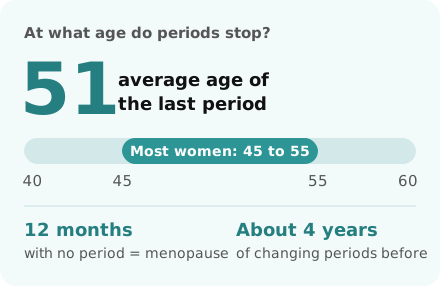
That average leaves a lot out. Periods rarely stop in one go, and your own age can be years either side of 51. This guide covers what usually happens, what affects your timing, and how to tell whether your periods are winding down.
In short:
- Most women have their last period between 45 and 55. The average is 51.
- Menopause means 12 months without a period. The years of change before that are perimenopause.
- Periods usually get closer together first, then further apart, before they stop.
- About 1 in 20 women reach menopause before 45, and about 1 in 100 before 40. Both are worth discussing with a doctor.
- Any bleeding after 12 months with no period should be checked.
Periods don’t just stop one day
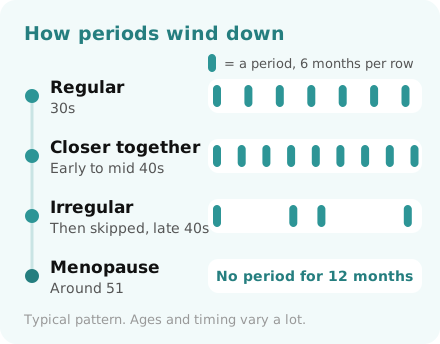
Some women have regular periods right up until they stop, but that’s unusual. Most go through perimenopause, a transition that often starts in the early-to-mid 40s and lasts about four years on average. For some it takes only a few months, and for others more than ten years.
During that time, your periods tend to change in a fairly predictable order:
- Cycles get shorter. A 28-day cycle becomes 24 or 21 days. This is often the very first sign (why periods get closer together in your 40s).
- Cycle length becomes unpredictable. It swings by a week or more from one month to the next. Flow may get heavier or lighter.
- You start skipping periods. Gaps of 60 days or more usually mean you’re in late perimenopause, often within a year or two of your last period.
- Periods stop. Once 12 months pass with no bleeding, your last period marks the date of your menopause.
Hot flashes, night sweats, broken sleep and mood changes often start or get worse in the later stages, when periods are spacing out. Here are 15 early signs of perimenopause that are easy to miss.
What affects the age your periods stop?
No test can tell you your exact age in advance, but some factors make earlier or later menopause more likely:
- Your mother’s and sisters’ age. This is one of the strongest clues. In one study, women whose mother or sister reached menopause by 45 were around six times more likely to do the same. Ask your mother, if you can.
- Smoking. Smokers reach menopause roughly 1 to 2 years earlier on average.
- Surgery. Removing both ovaries causes immediate menopause at any age. A hysterectomy that leaves the ovaries in stops your periods, but your ovaries keep working, and you may still reach menopause slightly earlier.
- Cancer treatment. Chemotherapy and pelvic radiotherapy can cause menopause during or soon after treatment, sometimes temporarily.
- Some medical conditions, including certain autoimmune and genetic conditions, are linked with earlier menopause.
Things like your age at your first period, or whether you’ve used the pill, make much less difference than many people think.
Is there a “normal” age? Early, premature and late menopause
| Age at last period | What it’s called | How common |
|---|---|---|
| Before 40 | Premature menopause or premature ovarian insufficiency (POI) | About 1 in 100 |
| 40 to 44 | Early menopause | About 1 in 20 |
| 45 to 55 | Typical age range | Most women |
| After 55 | Late menopause | Less common |
Before 45. If your periods stop or become very irregular before 45, see a doctor rather than waiting it out. Early menopause can be confirmed with blood tests (see what perimenopause blood work can and can’t show). It matters because losing oestrogen earlier raises the long-term risk of osteoporosis and heart disease. Hormone treatment is usually recommended until at least the average age of menopause, to protect your bones and heart.
POI isn’t always permanent. Periods can come back now and then, and pregnancy is occasionally still possible.
After 55. Still having periods after 55 isn’t necessarily a problem, and often runs in families. Longer exposure to oestrogen is linked with a slightly higher risk of breast and endometrial (womb) cancer, though, so it’s worth mentioning at your next check-up. See a doctor promptly if bleeding is heavy, irregular, or comes between periods.
Signs your periods are ending for good
There’s no single sign that tells you your last period has arrived, but these suggest you’re getting close:
- Gaps of 60 days or more between periods
- Periods that are much lighter or shorter than they used to be
- Hot flashes and night sweats becoming more frequent
- Vaginal dryness or discomfort during sex
- Being over 50 with periods already spaced months apart
The simplest way to know where you are is to write down the date of every period, including spotting. Without dates, it’s surprisingly hard to remember whether your last period was 7 months ago or 11. Our free printable tracker makes this easy, and the 2-minute perimenopause quiz can show which stage your pattern and symptoms point to.
Can periods come back after stopping?
During perimenopause, yes, often. It’s common to go six, eight or even ten months without a period and then have one. That’s why the 12-month rule exists, and why the countdown starts again if you bleed.
After 12 full months without a period, bleeding is not normal. It’s called postmenopausal bleeding. Most of the time the cause is harmless, such as thinning of the vaginal or womb lining or a polyp. Occasionally it’s an early sign of womb cancer, so always get it checked, even if it’s only spotting or happens once.
Can you still get pregnant?
Yes, until menopause is confirmed. Ovulation becomes less regular in perimenopause, but it doesn’t stop until your periods do. UK guidance is to keep using contraception until you’ve had no periods for 12 months if you’re over 50, or for 24 months if you’re under 50. Most women can stop contraception altogether at 55.
Hormonal contraception can hide your natural cycle, which makes it hard to tell when your periods would have stopped. If that applies to you, ask your doctor how to work out when it’s safe to stop.
When to see a doctor
Changing periods in your 40s and 50s are usually part of the normal transition. See a doctor if you have:
- Periods stopping or becoming very irregular before 45
- Very heavy bleeding, such as soaking a pad or tampon every hour or two, passing large clots, or bleeding for more than 7 days
- Bleeding between periods or after sex
- Periods regularly closer than 21 days apart
- Any bleeding after 12 months without a period
- Symptoms that are affecting your sleep, work or relationships. Treatment can help, and you don’t need to wait until your periods have stopped to ask.
Bring dates if you can. Here’s a checklist of what to bring to a menopause appointment.
Common questions
What is the average age for periods to stop?
51 in the UK and US. Most women have their last period between 45 and 55.
Can periods stop at 40?
Yes, but it isn’t typical. Menopause before 40 happens to about 1 in 100 women and is called premature menopause or premature ovarian insufficiency. Speak to a doctor, as treatment is usually recommended to protect your bones and heart.
Is it normal to still have periods at 55?
It’s less common but can be normal, especially if your mother had a late menopause. Mention it to your doctor, and get any heavy or irregular bleeding checked.
How do I know if my last period was my last?
You only know looking back. Once 12 months have passed with no bleeding at all, your last period is confirmed as your menopause.
Do you need a blood test to confirm menopause?
Usually not if you’re over 45. Doctors normally diagnose perimenopause and menopause from your age, your periods and your symptoms. Blood tests are more useful under 45, when early menopause is suspected.
How long do periods take to stop completely?
The change from regular periods to none usually takes several years. On average, perimenopause lasts about four years, but it can be much shorter or longer.
The bottom line
For most women, periods stop somewhere between 45 and 55, with 51 the average. They usually wind down gradually: closer together first, then further apart. The best guides to your own timing are your family history and a simple record of your periods. If you’re in your 40s and things are starting to change, now is a good time to start tracking.
Sources
- NHS: Menopause, Early menopause and Post-menopausal bleeding
- NICE: Menopause: identification and management (NG23)
- Cleveland Clinic: Premature and early menopause
- Faculty of Sexual and Reproductive Healthcare: Contraception for Women Aged Over 40 Years (2017, amended 2023)
- Morris DH et al. Familial concordance for age at natural menopause: results from the Breakthrough Generations Study. Menopause, 2011
- Morris DH et al. Body mass index, exercise, and other lifestyle factors in relation to age at natural menopause. American Journal of Epidemiology, 2012
This article is for general information and isn’t medical advice. Always speak to a qualified healthcare professional about your symptoms.
This article is for general information only and is not medical advice. Always consult a licensed healthcare provider about your symptoms.